
Main Types of Steel-Making Electric Furnaces and Smelting Processes
In a broad sense, the types of steel-making electric furnaces include electric arc furnaces (EAF), induction furnaces, electroslag furnaces, electron-beam furnaces, and others. “Electric-furnace steel” generally refers to steel produced in basic electric arc furnaces, so this article focuses on electric arc furnaces (EAF).
EAFs are divided into direct-current electric arc furnaces (DC-EAF) and alternating-current electric arc furnaces (AC-EAF). Because DC-EAFs can reduce the consumption of refractory materials, save energy, reduce noise, and cut flicker by half, their application has been increasing rapidly. Technologies such as eccentric bottom tapping, water-cooled furnace walls, water-cooled furnace roofs, oxy-fuel burners, and scrap preheating are well-suited for DC-EAFs and yield excellent results.
The 1990s marked a period of rapid development for DC-EAFs. In industrialised countries with high scrap recycling rates (such as the United States, Japan, and South Korea) and in developing countries with limited power supply (such as China and Southeast Asian nations), more than 100 EAFs with capacities over 50 t were built within only a few years. Representative examples include Japan's 240 t DC-EAF and the United States’ 280 t DC-EAF.
DC-EAFs use a single graphite electrode at the furnace roof, producing a stable and concentrated arc that promotes good molten-bath stirring and uniform temperature distribution, thus improving melting efficiency. A defining feature of DC-EAFs is that the roof graphite electrode serves as the cathode, while the anode is connected to the furnace bottom. This requires the furnace bottom to be electrically conductive.
The main conductive materials used for DC-EAF furnace bottoms include:
(1) Conductive refractories (ABB), and
(2) Metallic elements such as steel-bar electrodes (Irsid-Clecim), steel-plate electrodes (VAI), multiple steel-pin electrodes (GHH), and copper–steel composite water-cooled bottom electrodes.
Aside from the special requirements for furnace-bottom refractories in DC-EAFs, the refractories used in other furnace areas are largely similar.
Among AC-EAFs, the ultra-high-power electric arc furnace (UHP-EAF) is widely used. UHP furnaces offer high productivity, slow furnace-wall wear, shorter melting times, improved thermal efficiency, lower power consumption, and stable arcs. As a result, UHP-EAFs gained widespread adoption in the late 1970s.
In recent years, UHP technology has been developing toward larger capacities and higher power ratings. Some foreign UHP-EAFs have reached power levels of 1000 kVA/t or even higher, earning the designation of ultra-high-power arc furnaces. To maximise the advantages of UHP operation, several matching technologies have been developed, including water-cooled furnace walls, water-cooled roofs, and long-arc foamy-slag smelting.
In Europe, all EAFs above 30 t are equipped with water-cooled slag-retaining furnace walls and water-cooled roofs. More than 70% of Japanese EAFs use water-cooled furnace walls, and Western Europe and the United States have also adopted water-cooled slag-retaining walls.
The use of water-cooled walls can extend furnace-wall life to over 2,000 heats, reduce refractory consumption by more than 60%, increase productivity by 8–10%, reduce electrode consumption by 0.5 kg/t, and cut production costs by 5–10%. With water-cooled furnace roofs, roof life can reach up to 4,000 operations.
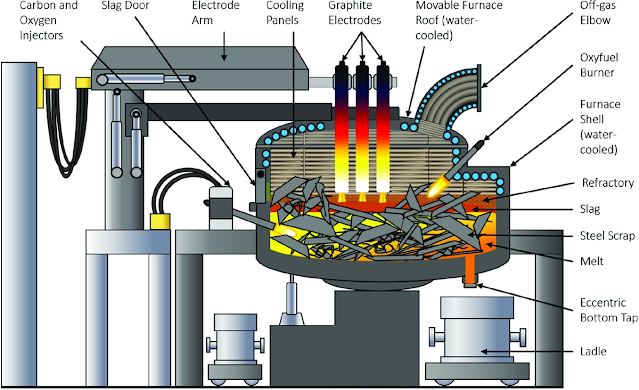
Electric arc furnaces can be classified by tapping method into spout-type tapping EAFs and eccentric bottom tapping EAFs (EBT), as shown in Figure 1. The EBT design enables a larger water-cooled area, lower refractory costs, and reduced slag carryover into the ladle, thereby increasing its adoption.
Electric-furnace steelmaking mainly uses scrap steel, metallised pellets, and similar materials. With arc temperatures reaching up to 4000 °C in the arc zone, a series of metallurgical and chemical reactions convert scrap into new steel, as illustrated in Figure 2. The smelting process typically involves three stages: melting, oxidation, and reduction. The furnace atmosphere can be adjusted to either oxidising or reducing conditions, enabling high efficiencies of dephosphorization and desulfurization.
In China, EAF steelmaking is mainly used for producing high-quality alloy steels. In recent years, with continuous innovations in EAF processes—including higher operating temperatures, larger furnace capacities, greater thermal shock intensity, and increasing quality requirements for alloy steels—refractory materials face higher performance demands.



.jpg)


没有评论:
发表评论