
Process Measures for Improving the Quality of Refractory Castables Used in Electric Furnace Steelmaking
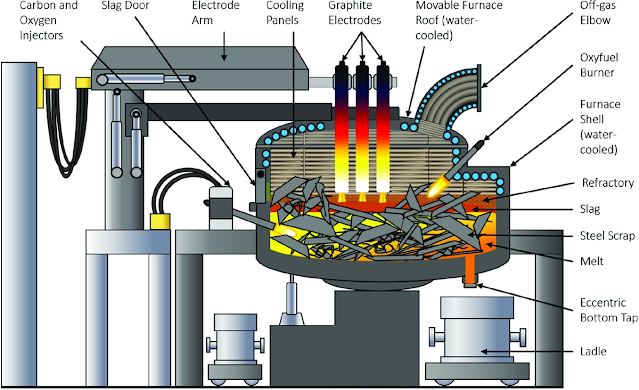
Electric furnace steelmaking uses electrical energy as the heat source. The furnace roof was originally built with silica bricks. In the late 1960s, high-alumina materials began to be tested, which offered better refractoriness, high-temperature corrosion resistance, and thermal shock resistance than silica bricks; thus, they were widely used in steel plants for many years. After the 1990s, fully water-cooled furnace-roof technology became widely adopted. To reduce furnace downtime and labor intensity, monolithic refractory castables—typically high-alumina or corundum castables reinforced with steel fibers—were commonly used in the electrode-triangle area.
To improve the quality of the castables, the following technological measures can be implemented:
-
Use high-purity raw materials with fewer impurities and good high-temperature volume stability, which helps enhance the high-temperature volume stability and corrosion resistance of the castables.
-
Minimize the CaO content, meaning reducing the amount of cement used, since an increase in CaO content significantly increases the amount of liquid phase, which is detrimental to the high-temperature performance of the castables.
-
Add an appropriate amount of α-Al₂O₃ to increase the material’s medium-temperature strength. α-Al₂O₃ can react with CaO to form CA and CA₂, resulting in a certain degree of volume expansion. This expansion helps compensate for the volume shrinkage caused by dehydration and phase transformation of the castables.
-
Add a suitable amount of soft clay as a sintering agent to promote liquid-phase formation and sintering, in order to achieve ceramic bonding.
-
Add an appropriate amount of an expansion agent (kyanite). The volume expansion generated during the mullitization of kyanite helps offset the volume shrinkage occurring during the sintering process.
-
Introduce heat-resistant stainless-steel fibers to improve thermal shock resistance and enhance material toughness, thereby reducing structural spalling and damage of the castables.
-
Add an appropriate amount of anti-explosion agent to allow water vapor within the castables to escape smoothly during baking, thereby improving the baking quality of the castables.



.jpg)


没有评论:
发表评论